How to choose homeschool work samples without keeping everything
Useful homeschool work samples show a starting point, a later attempt, or learning that would otherwise disappear.
By Homa
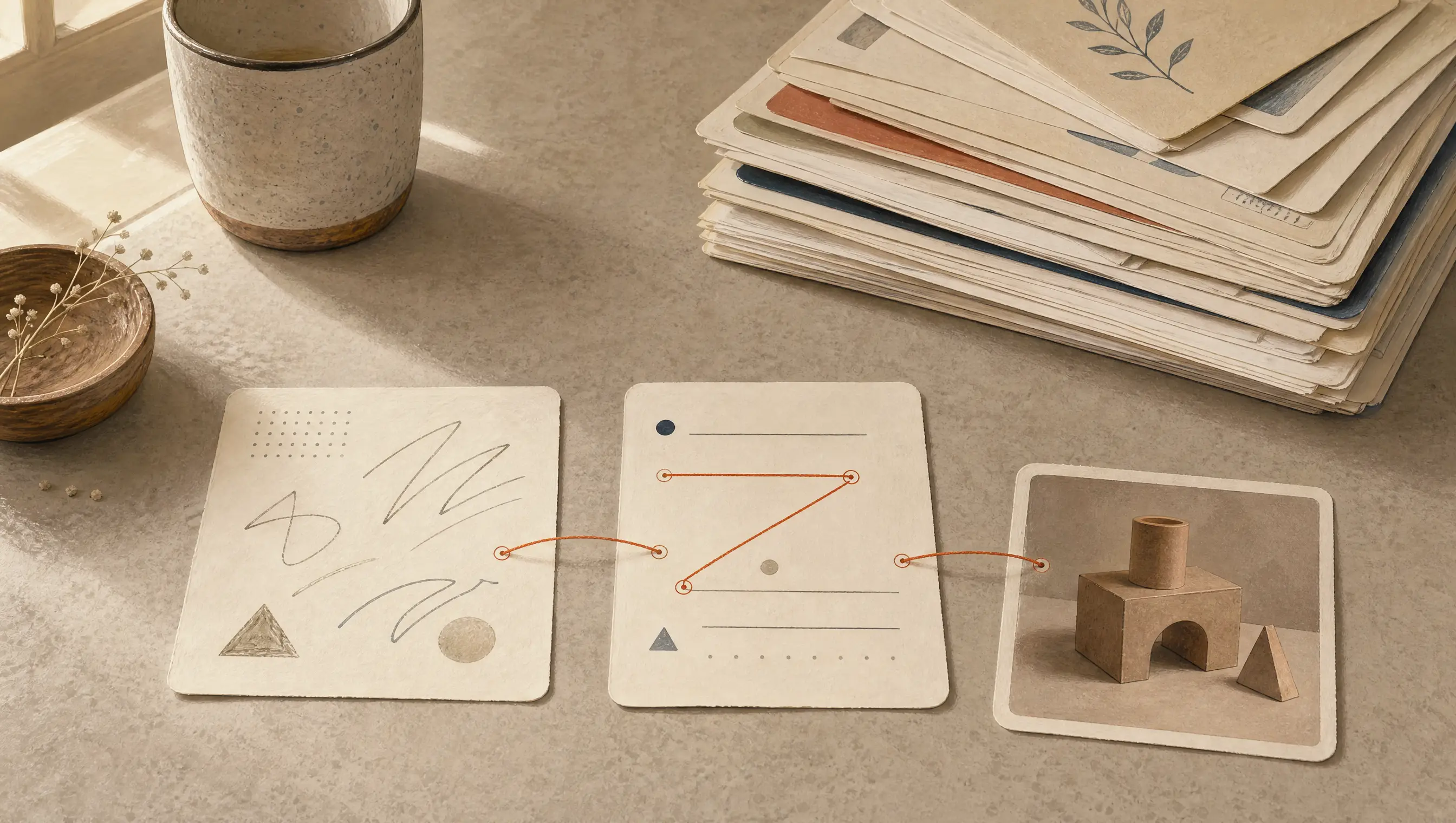
The stack contains math pages, several drawings of the same dragon, a damp leaf rubbing, and one paragraph everyone remembers because it took several mornings to say what it meant.
Keeping all of it is easy today and unwieldy by spring. Choosing becomes easier when every sample has a job.
A homeschool work sample earns its place when it shows a starting point, a later attempt at the same kind of work, or learning that would otherwise disappear. The date and one sentence of context make the sample understandable. When an outside reader will review the selected set, that reader's current instructions come before a general checklist.
Every sample needs one job
A page earns its place by answering a question. These three jobs cover many family-selected sets:
- Where did this begin? An early attempt makes the starting point visible.
- What changed? A later attempt shows the same kind of work again.
- What would disappear? A photo or note preserves a project, conversation, performance, outing, or build that cannot live in a paper stack.
A fourth identical practice page may be perfectly good work and still add nothing new to the record.
A useful pair can matter more than a favorite page
The prettiest final page does not always show the most useful story. A pair can.
A writing pair might hold an early paragraph and a later paragraph with a similar purpose. A math pair can show two attempts at the same idea. A reading pair can use two short notes about similar moments. A long project may be clearest through its first plan and finished result.
The comparison works only when the samples are related enough to make change visible. A page of single-digit addition and a page of fractions both belong to math, but they do not show the same kind of work over time.
One quick test keeps the comparison honest:
Could a reader point to the same kind of work in both samples?
If not, the pair may still be worth keeping, but it is not a before-and-after pair.
The support belongs with the sample
Sometimes the useful difference is not a cleaner final answer. It is the kind of support around the work.
One sample might include blocks, a number line, a word bank, a dictated first sentence, or a note that the directions were read together. A later sample may use different support, need a shorter reminder, or use the same tool in a new way.
A short note can preserve the support. Without it, two finished pages may look identical while the learning story between them disappears.
August 4: Built each fraction with folded paper before writing it.
September 12: Drew the fraction model independently, then wrote the answer.
The note describes the work. It does not announce a permanent trait about the child.
A photo can preserve work that will not fit in a binder
The cardboard bridge, garden bed, puppet show, bread recipe, repaired bicycle chain, and creek map do not need to become worksheets before they count as things the family wants to remember.
A useful photo sample includes:
- the date
- what the learner made or did
- one decision, explanation, or change that matters
“Science project” is a label. “Changed the bridge base after the first soup can tipped it” shows the decision the photo cannot explain by itself.
When several photos show the same process, one or two can make the change visible. A thirty-photo burst can remain in the camera roll.
Perfect work is not the only useful evidence
A selected set made only of polished pages can hide the decisions, revisions, and support that made the work interesting.
An unfinished plan may show the question that launched a project. A crossed-out sentence may show a better word arriving. A wrong answer with a changed model may show how the learner checked the idea.
The point is not to preserve mistakes for judgment. It is to keep the evidence that makes the later attempt understandable.
One line can explain why a sample belongs
When a page moves into the selected set, one line can travel with it:
Keep because: ______________________________________________
Useful answers include:
- first independent attempt at this kind of paragraph
- same fraction idea as the August sample
- only record of the model before it was recycled
- shows how the child began after the directions were read together
- required by the current portfolio instructions
If the line is hard to finish, the sample may belong in the temporary inbox rather than the selected set.
The homeschool portfolio checklist applies the same purpose-first test to a full portfolio.
A small temporary inbox keeps selection out of the lesson
Choosing every page the moment it is finished interrupts the day. Keeping everything until June creates a different problem.
One temporary place can hold possible samples. Once a month, at the end of a unit, or on another rhythm that fits the family, the few items with clear jobs can move into the selected set. Anything named by current instructions stays; the rest can be recycled or archived when it no longer adds useful context.
The inbox is allowed to be messy. The selected set works best when each item is explainable.
Outside readers choose their own requirements
An evaluator, umbrella program, scholarship, or local rule may name subjects, dates, sample counts, signatures, or other material. General portfolio advice cannot replace those current instructions. If a requirement is unclear, the contact information on the form or rule is the clearest place to ask.
The three-job rule can help you choose among acceptable samples. It cannot decide what another reader requires.
When selected work needs one home
The Homa digital binder stores worksheets, photos, and reports together. A saved page can be opened and printed again.
Homa gives selected work one place to live. You still choose why a sample belongs and what an outside reader needs.
Keep the pages that tell you something new
A useful set does not have to prove that every day happened. It needs enough context for the reader to understand the work you chose.
For a family-selected set, the three jobs can be enough: a beginning, a comparable later attempt, or work that would disappear. One honest line explains why each sample is there. The stack becomes smaller, and the story becomes easier to see.