How to make a practice page for the lesson in front of you
A focused homeschool practice page starts with the lesson, one skill, the amount of practice, the response, and a parent check.
By Homa
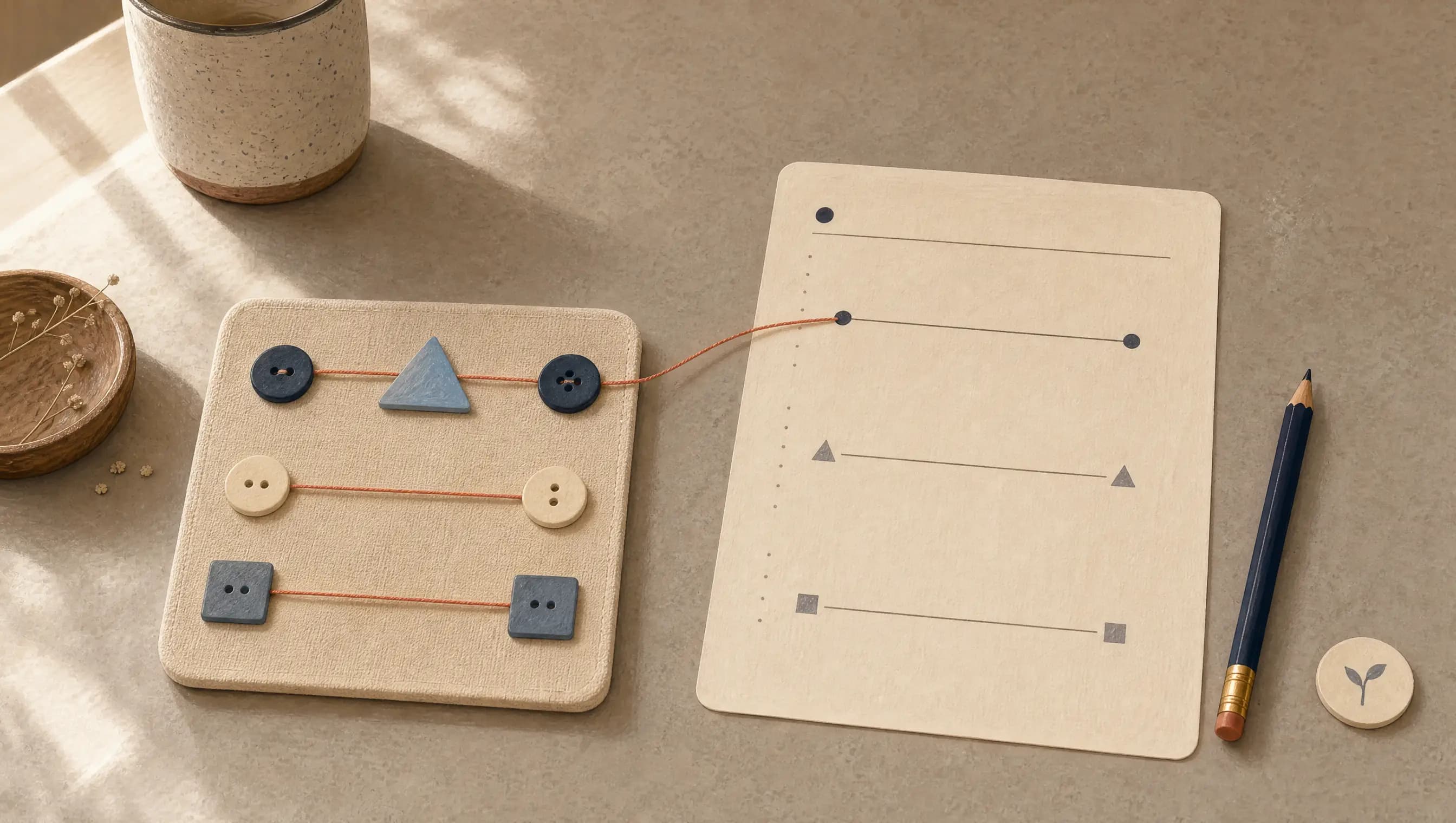
The lesson ends with one idea that needs another look tomorrow. You search for a worksheet and find a packet for the whole grade, a cartoon maze, and problems using a method your book has not introduced.
You do not need a bigger packet. You need a small piece of practice that belongs to this lesson.
A useful homeschool practice page starts with the exact lesson and one skill. The brief also names how much practice belongs, how the child can respond, and what the parent will check before printing. Those choices give the page one clear job.
The lesson before the grade
“Second-grade math worksheet” leaves almost every important decision open. The page could contain place value, measurement, money, addition, geometry, or something the child has never seen.
The starting point is what happened in the lesson:
- “We built equal groups with buttons.”
- “We read words ending in
-atand-an.” - “We identified the subject of a sentence.”
- “We compared halves and fourths with paper shapes.”
The lesson gives the practice page a boundary. It also gives you a fair way to check whether the page matches what you taught.
One skill you want to see
A practice page works better when every item helps you see the same thing.
For the equal-groups lesson, the skill might be “draw equal groups for a multiplication expression.” That is different from calculating a long mixed set of multiplication facts.
For the reading lesson, the skill might be “read and sort short words by ending.” That is different from reading a full passage and answering comprehension questions.
The skill can fit this sentence:
The child will ____________________.
If the blank keeps needing “and,” the page may be carrying more than one lesson.
Enough practice to see the pattern
More items do not automatically tell you more. Repetition can help when the child is practicing a familiar move. It can also hide the moment when attention, handwriting, or patience becomes the harder task.
An amount that lets the child begin, repeat, and show the idea again may be enough. Extra room leaves you space to add another item by hand if the page is still useful.
You can also split the page:
- a short example completed together
- a small set to try
- one final item that uses the idea in a slightly different way
The page should end because the learning purpose is complete, not because every corner of the paper has been filled.
Familiar context only when it helps
A child who loves frogs may enjoy counting lily pads. A child practicing subtraction does not need a long frog rescue story before reaching the numbers.
Familiar interests can make the task recognizable, create meaningful examples, or give the page a reason to exist. The decoration still serves the work.
Good context:
- groups of train cars for equal groups
- recipe amounts for fractions
- animal names for alphabetical order
- a museum map for following directions
Context is not personalization if it makes the directions harder to understand. The next step should be obvious at a glance.
The response the child will make
Many weak worksheets have a clear topic and an unclear action. The page needs to show what the child will do:
- circle
- draw
- match
- write a number
- explain in one sentence
- build with objects, then record
- choose an answer and show why
The response should fit the lesson. If the child is learning to hear a sound, a page requiring a full written paragraph has changed the task.
For a child who finds writing physically demanding, the page might allow pointing, circling, moving pieces, or telling the answer to the parent. You decide what the practice is meant to reveal.
A practice-page brief
You can fill in this brief before making a page yourself or requesting one from a tool:
Lesson we just did:

One skill to practice:

Amount of practice:

Familiar context, if useful:

How the child will respond:
Example:
Lesson we just did: Built equal groups with buttons
One skill to practice: Draw groups for a multiplication expression
Amount of practice: One example together, a short set, one new context
Familiar context, if useful: Train cars
How the child will respond: Draw the groups and write the total
That brief is specific enough to guide the page and short enough to write while the lesson is still fresh.
The parent check before printing
Before the page reaches the table, a parent check can cover every item.
- Does each question practice the named skill?
- Are the directions understandable on the first read?
- Does the answer key match the actual question?
- Is any required information missing from an image or diagram?
- Did the difficulty change halfway through without explanation?
- Is there enough physical room for the response?
- Would the page still make sense in black and white?
Generated pages can contain mistakes. Downloaded pages can miss the lesson. Your review is the point where a possible page becomes one you choose to use.
If the practice belongs in a larger week, the weekly homeschool planner template can give it a place without turning it into another fixed appointment.
How Homa makes a lesson-specific page
Homa’s personalized practice-page feature begins with the lesson you name. You can ask for a familiar detail or another change, then keep the generated page in the digital binder for printing.
Homa does not remove the parent check. You still choose the lesson, inspect the result, and decide whether the page belongs in tomorrow’s work.
One page, one useful job
A practice page does not need to represent an entire grade or prove an entire subject. It can simply give tomorrow’s lesson the right starting point.
When the page knows its one job, your child does not have to wade through work that belongs to another lesson. You can see what tomorrow needs and stop there.